Mathematical Foundations of Deep Learning
Key Mathematical Concepts in Deep Learning
Deep learning is built upon several fundamental mathematical concepts that are taught in standard calculus and linear algebra courses. Understanding these concepts is crucial for grasping how neural networks function and how they are trained.
- Chain Rule: The core of the backpropagation algorithm
- Partial Differentiation: Essential for handling multiple variables in neural networks
- Gradients: Vectors that indicate the direction of steepest ascent/descent
- Vectors and Matrices: Enable efficient computation in neural networks
- Optimization Theory: Helps find minima of complex loss functions
These mathematical concepts form the foundation of deep learning. The beauty of neural networks is that they're essentially applied calculus at scale. Understanding these connections can help students see the relevance of the mathematics they're learning.
The Chain Rule in Neural Networks
The chain rule is perhaps the most important calculus concept in neural networks. It allows us to calculate how changes in the input affect the output through multiple layers of transformations. This is the mathematical foundation of the backpropagation algorithm.
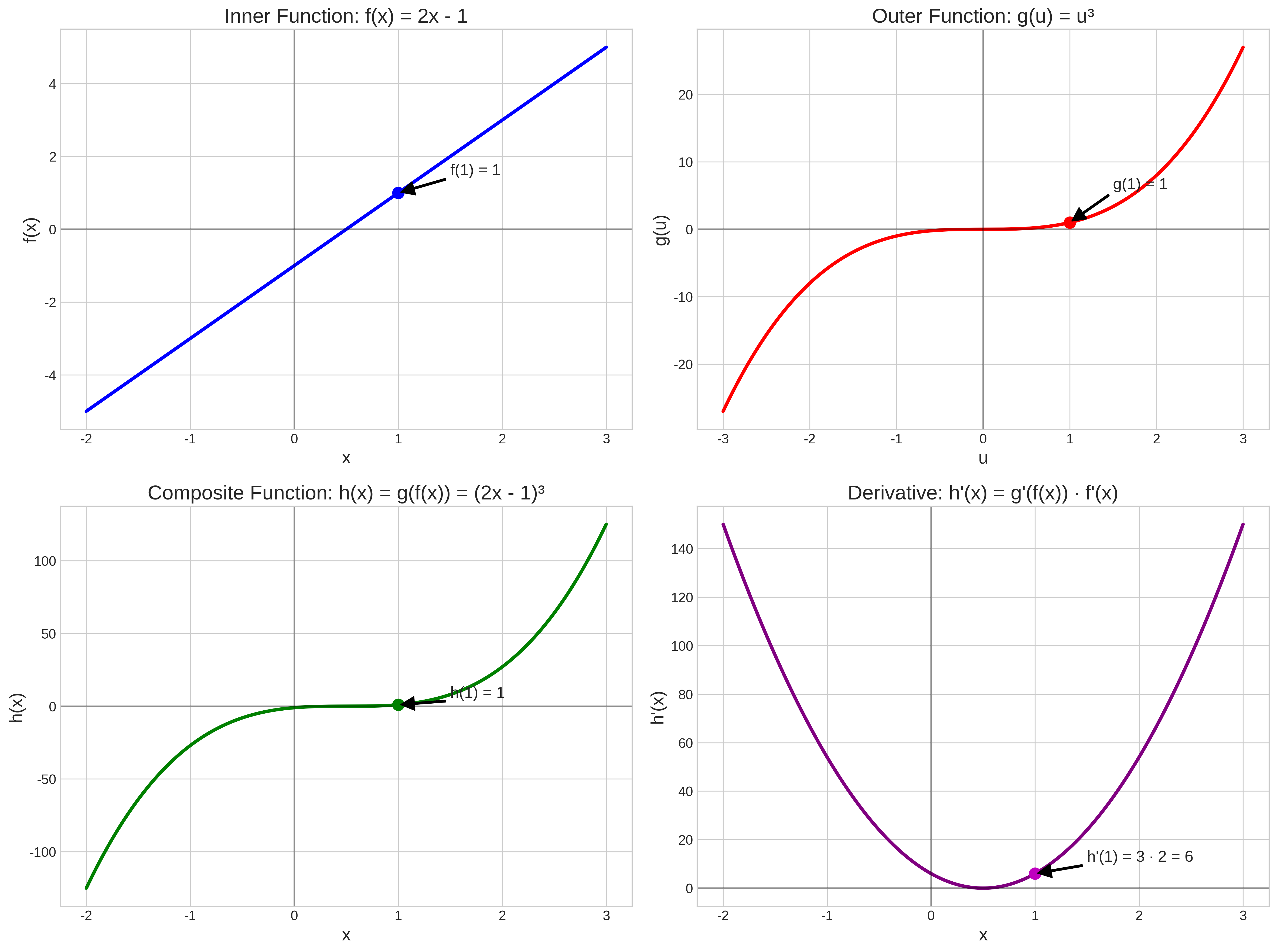
The chain rule allows us to compute derivatives through compositions of functions
In calculus, the chain rule states that if y = g(f(x)), then:
dy/dx = (dy/du) * (du/dx) where u = f(x)In neural networks, we have compositions of many functions (layers), and the chain rule allows us to compute derivatives efficiently by working backward from the output to the input.
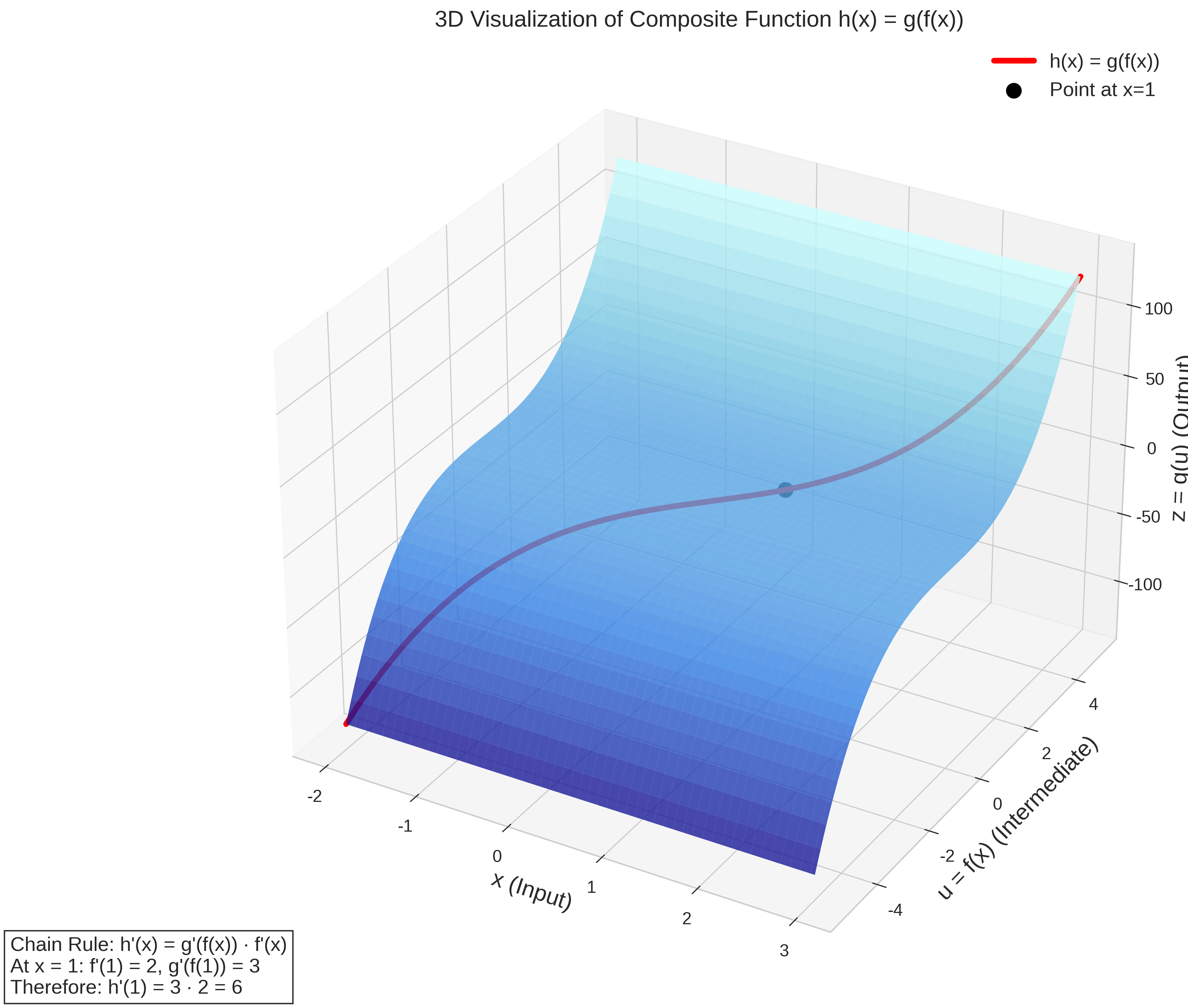
Visualizing the chain rule in three dimensions
This 3D visualization helps us understand how the chain rule works in practice. We can see how changes propagate through the composite function. In neural networks, we have compositions of many functions, and the chain rule allows us to compute derivatives efficiently.
Partial Derivatives and Gradients
Neural networks have many parameters (weights and biases) that need to be optimized during training. Partial derivatives help us understand how changing each parameter affects the output.
- Neural networks have many parameters (weights and biases)
- Need to compute how each parameter affects the output
- Partial derivatives measure rate of change with respect to one variable
- Gradient vector contains all partial derivatives
- Gradient points in direction of steepest increase
Partial derivatives are essential because neural networks have many parameters. We need to know how changing each parameter affects the output. The gradient vector, which contains all partial derivatives, tells us the direction of steepest increase, which is crucial for optimization.
For a function f(x, y, z), the gradient is:
∇f = [∂f/∂x, ∂f/∂y, ∂f/∂z]In neural networks, we compute the gradient of the loss function with respect to all parameters to determine how to update them during training.
Gradient Descent Optimization
Gradient descent is the optimization algorithm used to train neural networks. It works by iteratively moving in the direction of steepest descent (negative gradient) to find the minimum of the loss function.
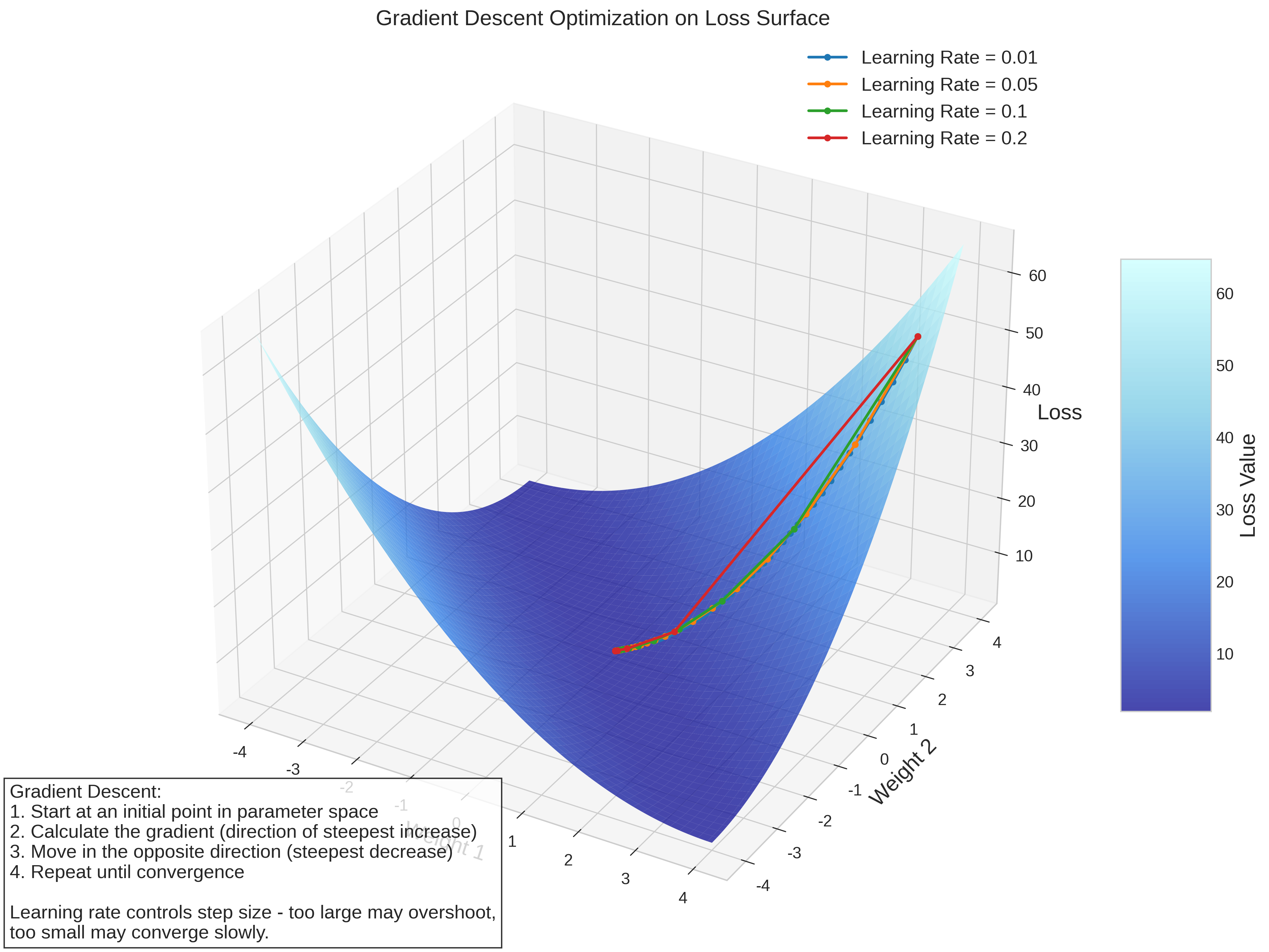
Gradient descent finds the minimum of the loss function by iteratively moving in the direction of steepest descent
The basic algorithm for gradient descent is:
θ = θ - α * ∇J(θ)where:
- θ represents the parameters (weights and biases)
- α is the learning rate (step size)
- ∇J(θ) is the gradient of the loss function with respect to the parameters
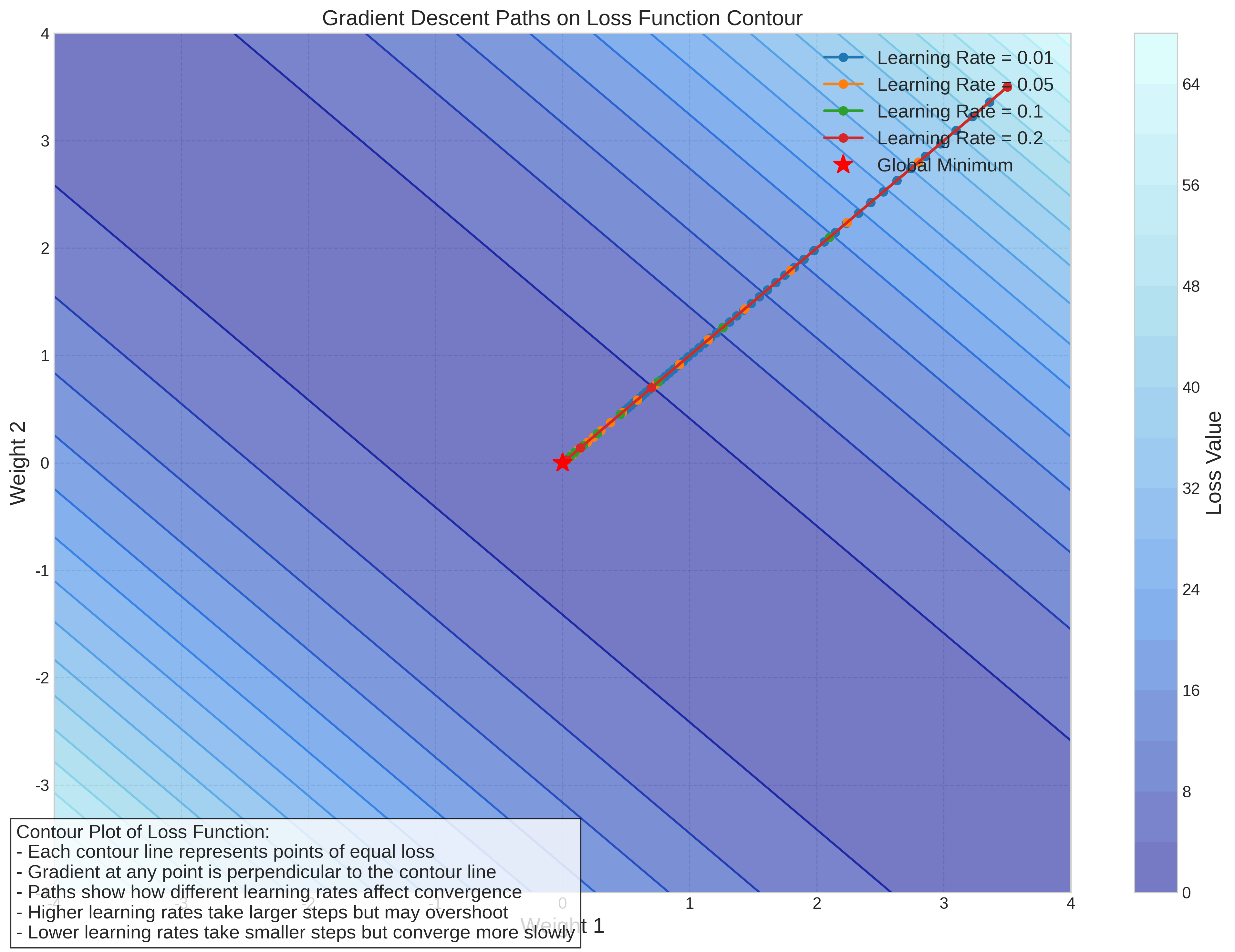
Contour plot showing gradient descent paths with different learning rates
This contour plot shows gradient descent paths with different learning rates. Notice how higher learning rates take larger steps but may overshoot the minimum, while lower learning rates take smaller steps but converge more slowly. Finding the right learning rate is a key challenge in training neural networks.